Why are sparkling wines bubbly?
Sparkling wines, unlike still wines, undergo a second round of fermentation inside the bottle. Wine and sugar (dosage) is added to the existing wine in the bottle which induces this secondary fermentation, producing carbon dioxide that is then retained within the bottle and that's where the bubbles in sparkling wine come from.
Are all sparkling wines called Champagne?
Champagne is a sparkling wine style produced in northern French region of Champagne. Legally, only sparkling wine produced in Champagne are allowed to be called Champagne. Champagne is in fact one of the oldest sparkling wine styles and is widely considered to be the best
How many days does a wine stay fresh once opened?
A wine bottled once opened can stay fresh for upto four days once recorked and sparkling wine retain their bubbles for upto two days provided the wines are closed with a Champagne stopper.
How does red wine get its color?
Red wine gets its colour from the skin of the grape. During fermentation, the skin is left with the juice for a limited period of time to allow for a process called maceration. The intensity of the colour is determined by the amount of time that the winemaker chooses to macerate during fermentation.
What does the year printed on the wine bottle mean?
The year printed on the label signifies the year when when the grapes were harvested to make the wine contained in the bottle. The year of harvest is also known as Vintage.
Why is wine swirled in the glass before sipping?
It is essential to swirl a glass of wine before nosing and sipping the wine as the process of swirling releases a number of delicate aromas and flavours that make the wine complex and sumptous. Swirling the wine also reveals the wine's tears on the side of the glass which is a good indication of the wine's texture.
Why do French & Italian wines don't mention grapes on the bottle label?
French and Italian winemakers have to adher to set of strict rules, chief among which is to use grapes that are best suitable for the specific regions based on the topography and climate, also known as 'Terroir'. These countries place more importance on the terroir than individual grapes hence it is always the region and classification that is mentioned and not the grape.
Why are French wines sold in different shapes? Is it region specific?
Bordeaux, Burgundy and Alsace have unique bottle shapes, each with their own unique history. Bordeaux wines were in fact the first ones to be aged for decades in cellars and the shape allowed its shoulders to prevent the sediments from entering the wine glass while Burgundians who take traditon very seriously have retained the age old elegant shape. The Alsatians opted to use sleek bottles so that the wines were easier to transport by river into neighbouring countries. These region specific shapes today have a great international profile as other wine making countries have generously used bottles of all three shapes to contain their wines.
Does the sulphite in the wine cause headache/hangover?
Sulphite in wine are a naturally occuring substances found in dried fruits, fruits and juices. Winemakers add sulphites to their wine so as a protect it from bacterial attacks and other forms of spoilage. Headaches from wine drinking may sometimes be cause due to certain chemicals used in the vineyard or winemaking process. Choosing wines that are produced using organic and biodynamic farming practices will ensure there are no more headaches.
Does farming practices like Biodynamic, vegan influence the taste of the wine?
Yes, these farming practices do positively influence the taste of wine. In fact, these wines beam with the truest expression of their terroir since the viticulturist and winemaker both have put a lot of thought and hard work into making the wine's journey from grape to glass as natural as possible. Organic and sustainable farming imbue the wine with a true sense of the soil and micro-climate as well as vastly improve the health of the vines, thereby ensuring that they bear high quality fruit for many vintages to come.
Why is wine served less compared to its glass size?
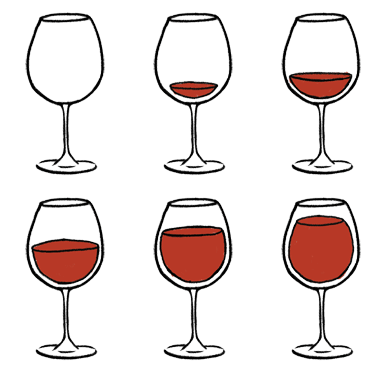
It is always important to swirl wine before tasting it. And to allow for a good swirl, the wine needs a good amount of bulbous space to slosh around a bit and breathe, releasing the vital aromas. Hence, the standard 125 ml per pour.
Is there any specific reason for white wine glasses having smaller bowl and shorter stem compared to red wines?
That's a good question. White wines have a distinct style compared to red wine, especially with regard to aromas which can be quite delicate. The white wine glass' shorter bowl allows one to bring the wine closer to one's nose, which helps in picking up the whole array of notes. Red wine glasses are bigger so that there is a surface area which allows us to observe the wine's colour and viscosity as it is swirled. The length of the wine glass stem is directly proportionate to the size of the bowl and ensures that the wine's temperature is no way affected by the temperature of the hand holding the stem.
Is sugar added in sweet wines or it’s naturally sweetened?
Now this one is tricky. Some winemakers allow for some amount of natural residual sugar to remain in the wine post fermentation while some might add sugar to the wine as long as they are legally allowed to. The process of adding sugar to the wine is called Chapatalisation. This practice is common in many German wine regions, namely Mosel and Rheingau which produce some amount of sweet white wines. This practice is not permitted in France and Italy. Famed sweet wines from Sauternes (France) and Emilia Romagna (Italy) are imaginatively produced by winemakers who leave a certain amount of grapes on the vine for much longer, allowing for fungus to attack grapes in a natural process called Noble Rot. A notable Italian grape Lambrusco has the capacity to produce delightfully sweet red wines.
Why should wines be stored on the side?
Now this is an interesting question. Wine bottles, especially those under cork closure must always be stored on their side so that the wine stays in contact with the cork and keeps it moist. This allows the cork to stop any oxygen from seeping into the bottle which could potentially oxidate the wine. If the cork is dry, it will let in the oxygen, thereby irretrievably spoiling the wine.
Do winemakers add flavors to the wine?
No, winemakers donot add any flavour to their wine. Every grape variety has a unique set of compounds that are similar to taste profile of apples, lemon, cherry, chocolate and so on and each of these compounds are enlivened during chemical reactions that occure during the fermentation process. The intensity of these flavours are determined by the style of the wine.
What does “legs” in a wine mean?
Legs in wine give the drinker a fair indication of the wine's alcohol and sugar levels. Sometimes also referred to as tears, these transparent and thick columns form on the side of the glass as a result of swirling the wine. Observing the wine's legs can give you a good measure of the wine's alcoholic wines -- the more thicker they are, the higher the alcohol level and vice versa. Ditto for viscosity or weight of the wine. Making inferences from the wine's legs is a great start towards becoming a wine pro!
What does a well balanced wine mean?
A wine is is regarded as well balanced when all the vital elements that a constitute the wine -- body, acidity, tannins and alcohol -- are in perfect harmong and complement each other. Acidity is the backbone of the wine while tannins supports the wine's body. It is important for the winemaker to streamline the wine's adicity with its fruit flavors and body so that the wine is well balanced and also food friendly.
Is there any accessory that allows wine to be poured without opening its cork?
Yes there is. Modern tech has invented some handy new tool for wine enthusiasts and chief among them is Coravin. This relatively new wine accesory, introduced in 2016, has a thin needle that pierces the cork and pours the wine into the glass, immediately filling the vacuum in the bottle with argon. Argon is an inert gas which prevents any oxygen from entering the bottle and cork stays in place to protect the wine. Some restaurants in India presently use the Coravin, primarily to serve wine connoiseurs that enjoy high end wines but cannot finish a bottle on their own. Coravin is also available online for consumers to buy.
Why do wines made from the same grape in another region tastes so different?
The answer lies in the terroir where the grape is grown, harvested and vinified. Every grape variety contains a distinct set of chemical compounds that represents a particular style of aroma and flavour profile. Howevere, there are a number of significant factors like soil, climate, surrounding flora and fauna, topography and the winemaker approach, allow of which play a role in defining the wine's character and style whch is then associated with the particular winery, sub region or region at large. For instance, Chablis and its chalky clay mix soils (Kimmeridge clay) makes it unique Chardonnay unlike other Burgundian Chardonnays.
Can you enjoy red wines with white meat and vice versa?
Food and Wine Pairing is an an age old culture, passed down through generations and interestingly, it is also quite modern in that there are no set rules. Yes, a general suggestion, red wine is reccommended for red meats and white wine for white meat but millenials have broken the rules and hit upon some interesting pairing ideas. Eventually, it is about your personal preference, being mindful of some key points. Always match the intensity of the wine and food as well as the weight. The sauce contained in the dish should compliment or enhance rather than clash with or overwhelm the wine. Feel free to experiment with your pairings and we also have a comprehensive food pairing guide for all of our wines for your perusal.
What are ‘wine diamonds’? Do winemakers add small crystals as a part of wine making process?
No, the winemakers don't add any crystals to the wine. Wine diamonds are essentially tartrate crystals that occur naturally in a wine when it is chilled beyond its serving temperature. The overchilling causes the wine's tartaric acid to forms crystals which are completely harmless and melt back into the wine as its temperature rises.
How long can I store wines without opening them?
Now while its a popular belief that wine gets better with age, that's not true for every wine. Each wine has its own 'drinking period' based on the method of production as well as oak and bottle ageing. Certain iconic red wine styles like Barbaresco, Barolo, Brunello Di Montalcino and Bordeaux growths have the potential to age for 20 to 50 years when laid down in good wine cellars with constant temperature and safety from sunlight. Young wines or 'Drink Now' wines as some people call them can be consumed immediately or can even keep for two to eight years, depending on the individual style and body.
Does cork or screw cap say anything about the wine quality?
In today's date, certainly not. There's always a debate about wine closures that rages among those in the wine business but for all practicaly purposes, wine under screwcap is just as good as wine under cork. Infact, countrys like Australia and New Zealand close most their of their wine under screw caps. While a lot of high end red wines are still only closed under cork, when it comes to entry to mid level wines, screwcap and cork are both widely used and are in no way indicative of the quality of wine in the bottle.
What is decanting? Could white wines be decanted or only reds?
The age old process of decanting the wine requires one to slowly pour wine from the bottle into a big and shapely crystal glass vessel. Decanting is beneficial for all wines -- young wines get aerated and open up to drink fabulously while older wines get to breath after years if not decades inside a bottle and express their aged style. Decanting is also done to remove sediment from aged older vintage wines. While decanting is mostly done for red wines, some barrel aged older vintages of white wine can also be decanted though it is rarely done.
Does the decanter shape matter? Or is it just for styling/marketing?
Decanter comes in several shapes and sizes, namely swan, cornett, duck, and even snakes. These shapes aren't entirely superflous and do serve a purpose though they do come at a steep premium and are certainly nice to look at. Standard decanters do the job of aerating the wine and draining it of its sediment just as well.
On what parameters do critics rate wine?
Thats's a huge question. Wine Critics are active tasters, running through several hundreds of wines and making dilligent notes. Each one though claims to have his or her own unique approach apart from the standard thumb rule of judging the wine on the balance of its elements, style and quality. Some of the standard parameters of judging a wine also include vintage, region, aging process and of course, price. The critics thoroughly analyze the wine by nosing and tasting it and write their personal notes. Their evaluation of any given wine is also based on their consious memory of having tasted several wines of each varietal and style which holds them in good stead.
Why do critics rate wines every year? Do the vintage specific ratings matter?
Yes, vintage specific ratings matter a whole lot. What makes wine unique in the alcohol universe is that wine can differ not just by region or even neighbouring vineyard but by the year of vinification. It comes back to terroir, especially climate before and leading up to harvest time. Some vintages are epic and sought after while some can be average or worse. Wine professionals and serious enthusiasts make it a habit to read vintage reports. And critics rigorously taste and rate every wine by its vintage because every vintage produces a different wine.
Do Vivino ratings really say anything about the wine quality?
ViVino is one of the world's most credible and democratic platforms for wine ratings. Here all the wines are rated and commented on by people who love drinking wines and buy them frequently. So yes, ViVino ratings say quite a bit about the quality of the wine, perhas not in the consistent and structured way that a wine critic would but in way that many of us relate to and would probably rate it, ourselves.
The older the wine, the better? How true is that…
Well, it's not. Older wine is not neccessaily better. 80 per cent of all wine produced in the world is meant to be consumed within 2 to 5 years of bottling. As mentioned earlier, certain red wines from iconic regions in the old and new world have the potential to age for a long time but that does not hold true for all wines.
Can all wines be enjoyed young? What does ‘drinking period’ mean? Who decides it?
Wine is all about style and character which is defined by how the wine is produced and subsequently aged. Most wine styles are meant to be consumed young or after perhaps a couple of years of ageing. Now there are some red wines that, owing to where they are produced and the sheer complexity of flavours and tannins, need years of barrel ageing and then some cellaring. Some winemakers are so particular about this that they go to the extent of storing the bottles at their own cost and release them when they believe the wines have reached prime expression. The drinking period is therefore decided largely by the wine producers as well as expert critics like Robert Parker, James Suckling, Jancis Robinson who recommend the drinking period as part of their tasting notes.
What’s so special about expensive wines?
Wine is entirely subjective though pricing the wine is entirely at the wine producer's discretion. That being said, critics and consumers both play an important role as does the wine's region and classification in determining the eventual price of wine. Just like most wine is meant to be consumed young, most of the world's wine is inexpensive. Some wines at the top end however are eye wateringly expensive, especially Bordeaux's First Growths, certain Tuscan appellations and practically any wine that reads Burgundy on the label. To put it crisply, expensive wines earn their price because they taste sublime and both the critics and those who pay for the wine, know that it's totally worth it.
Any movie documentary or book recommendations based on tasting wines?
Sure, there's so many. When it comes to movies and documentaries, do watch Sideways, A Good Year, Somm series, Barolo Boys and Sour Grapes. Some great wine books to always keep include Sommelier's Atlas of Taste by Rajat Parr, Adventures on the wine route by Kermit Lynch, The Wine Atlas by Hugh Johnson and Jansic Robinson and The Robert Parker Wine Buyer's Guide.
How many human senses are involved in wine tasting?
Sensory wine tasting involves a step by step process starting with observing the wine's rim, its colour in the centre and the weight of the wine as it moves in the glass upon swirling. The next step involves sniffing the wine and letting the aromas interact with the olfactory senses -- 80 per cent of the wine is decoded through the nose for smells like earth and forest floor. The third and final step is to taste where you swirl, swoosh and gargle the wine inside the mouth so that it touches every part of the tongue responsible to receptors for sour, sweet, bitter and salty. So all of our three primary senses -- eyes, nose and tongue -- play an indispensible role in experiencing the wine.
How many calories are present in a standard glass of 150 ml wine?
Around 150 to 200 calories & maximum sugar upto 36 to 45 gms per litre in sweet wines & minimum of 1 to 3 grams in dry wines.
What does the world 'dry' mean with regard to wine?
Technically, any wine with little to no residual sugar is considered to be a dry wine. That said, mostly all modern wine is dry with the exception of sweet and fortified wine. The dry character of the wine is a largely a given and the wine is described mostly by its aromas and flavours. The dry character in white wines manifests itself with crisp acidity while with red wines, it's the tannins.
 Our Key Wines